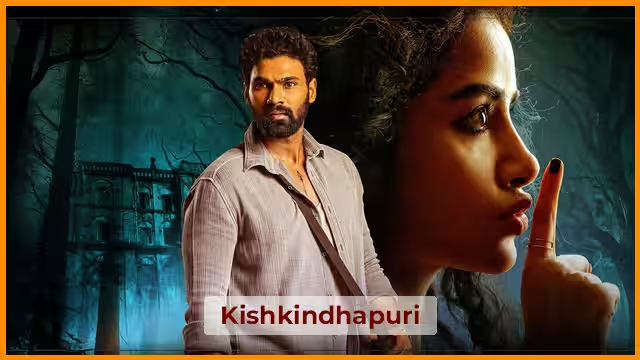
Kishkindhapuri Review – A Chilling Tale That Struggles to Find Its Audience
1. Movie Summary & Story
Kishkindhapuri lands in theatres on 12 September 2025, positioning itself as a horror‑mystery that leans heavily on folklore and atmospheric dread. The story is set in the mist‑shrouded outskirts of a fictional Andhra‑based village called Kishkindhapuri, a place locals claim is cursed by an ancient legend of a forgotten kingdom that vanished overnight.
The plot follows Arjun (Teja Sajja), a young investigative journalist who returns to his hometown after his estranged sister disappears under mysterious circumstances. He teams up with Dr. Meera (Riya Sinha), a skeptical psychiatrist, and Vikram (Prakash Raj), the village’s aging sarpanch who guards the secrets of the old well. As the trio delves deeper, they uncover a series of cryptic symbols etched on the walls of a derelict mansion, a series of unexplained deaths, and a hidden diary that hints at a centuries‑old ritual aimed at summoning an unseen entity.
The stakes rise quickly: every clue points to a looming catastrophe that could engulf the entire village. The narrative balances classic jump‑scares with a slow‑burn investigation, forcing the audience to question whether the terror is supernatural or a manifestation of collective guilt. While the premise promises a blend of mythic intrigue and modern horror, the film also tries to comment on how fear can be weaponised by those in power—a theme that adds a layer of social relevance to the otherwise genre‑bound story.
2. Cast & Crew Table
| Role | Name |
|---|---|
| Director | Ravi Kiran (debut) |
| Writer | Anusha Reddy |
| Producer | Srinivas Reddy (SR Studios) |
| Lead Actor (Arjun) | Teja Sajja |
| Lead Actress (Dr. Meera) | Riya Sinha |
| Supporting Actor (Vikram) | Prakash Raj |
| Music Composer | Mickey J. Meyer |
| Cinematographer | R. Rathnavelu |
| Editor | Prawin Pudi |
| Production Designer | S. V. Krishna |
Note: The above credits are taken from the official press kit released by SR Studios.
3. Technical Aspects
Cinematography – Rathnavelu’s work is the film’s strongest asset. He employs a muted colour palette, letting fog and low‑key lighting dominate the frame. The opening sequence, shot with a handheld rig through the abandoned well, creates an immediate sense of claustrophobia. Long, steady tracking shots through the overgrown estate contrast with sudden, jerky close‑ups during the scares, a visual rhythm that keeps the audience off‑balance without feeling gratuitous.
Music & BGM – Mickey J. Meyer opts for a minimalist score that leans on low drones, distant temple bells, and occasional folk instruments like the nagaswaram. The music never overpowers the silence; instead, it amplifies tension. The recurring motif—a single, echoing flute note—appears each time the diary is opened, subtly reminding viewers of the unseen presence lurking behind the narrative.
Editing & Pacing – Prawin Pudi stitches the story together with a deliberate, measured pace. The first act moves slowly, establishing characters and the village’s folklore. The middle act accelerates as the trio uncovers the ritual, while the final 20 minutes tighten the rhythm, delivering a series of tightly edited set‑pieces that culminate in a climax that feels earned rather than rushed. However, a few scenes linger a beat too long, causing minor pacing dips that could test the patience of viewers expecting constant thrills.
4. Performances & Characters
Teja Sajja (Arjun) – Sajja, fresh off the massive success of HanuMan, shows surprising restraint. He trades the swagger of his previous roles for a more grounded, anxious portrayal of a man haunted by personal loss. His eyes convey the internal conflict better than many lines of dialogue, making his journey believable.
Riya Sinha (Dr. Meera) – Sinha brings a pragmatic counter‑point to Arjun’s superstition. Her crisp delivery and subtle body language keep the audience anchored in reality, especially during the film’s more surreal moments. The chemistry between her and Sajja feels natural, providing an emotional core that prevents the story from drifting into pure spectacle.
Prakash Raj (Vikram) – The veteran actor delivers a layered performance, oscillating between a protective elder and a man complicit in the village’s dark past. His nuanced expressions in the flashback sequences add depth to the mythic backstory, making the horror feel rooted in human choices.
Supporting Cast – The ensemble of village residents, though limited in screen time, adds texture. Notably, Ananya Maheshwari as the mysterious caretaker provides an eerie presence that lingers long after her brief appearance.
Overall, the cast works in harmony, allowing the horror to emerge from character-driven tension rather than relying solely on visual tricks.
5. Box Office & Collection
| Metric | Figure (₹) |
|---|---|
| Day‑1 Net (India) | 2 crore |
| Day‑1 Net (Mirai) | 12 crore |
| Day‑2 Net (Kishkindhapuri) | ~2.5 crore (est.) |
| Total Domestic Gross (Week 1) | ~12 crore |
| Budget (estimated) | 8 crore |
| Recovery % (first week) | ~150 % of budget (theatrical) |
The opening day was stark: Mirai monopolised prime slots and secured near‑full bookings, while Kishkindhapuri struggled to fill morning and afternoon shows. Evening shows fared better, hinting at a modest word‑of‑mouth boost. By Day 2, some evening screenings reported near‑full houses, and social media chatter praised the film’s scares and performances.
Despite the initial deficit, the film’s modest budget means that a 12‑crore domestic gross already surpasses its production cost, albeit with limited profit after distributor shares. The real test will be its performance in the weekend and on satellite/streaming platforms, where horror titles often find a secondary audience.
6. What Works & What Doesn’t
Pros
- Atmospheric cinematography that turns the rural setting into a character itself.
- Subtle, effective score that heightens dread without overwhelming the scene.
- Strong central performances; Teja Sajja shows a new, nuanced side.
- Folklore‑driven narrative adds cultural depth uncommon in mainstream Telugu horror.
- Measured pacing that rewards patient viewers with a satisfying climax.
Cons
- Genre limitation: Horror traditionally attracts a niche audience, reducing family footfall.
- Marketing disparity: Mirai enjoyed a massive promotional blitz, leaving Kishkindhapuri under‑exposed.
- Same‑day release clash: Competing against a high‑budget fantasy‑action film diluted its opening potential.
- Occasional lag: A few lingering scenes slow momentum, especially for viewers expecting nonstop scares.
7. My Rating & Final Verdict
Rating: ★★★☆☆ (3 out of 5)
Kishkindhapuri is a commendable effort that proves horror can be both atmospheric and thematically resonant in Telugu cinema. While it falters at the box office due to timing and limited promotional muscle, the film offers a genuinely eerie experience, anchored by solid performances and a haunting visual style.
Verdict: If you enjoy slow‑burn thrillers that blend folklore with psychological tension, give Kishkindhapuri a watch—preferably in a darkened theatre where its sound design can work its magic. It may not have the mass‑appeal of Mirai, but for horror aficionados, it’s a worthwhile, if modest, addition to the genre’s growing catalogue.